Menstrual Theology of Resurrection
Lessons from Endometrium Research

This scientific paper moved me to tears and revealed something precious about God, about scars, resurrection, suffering, and disability.
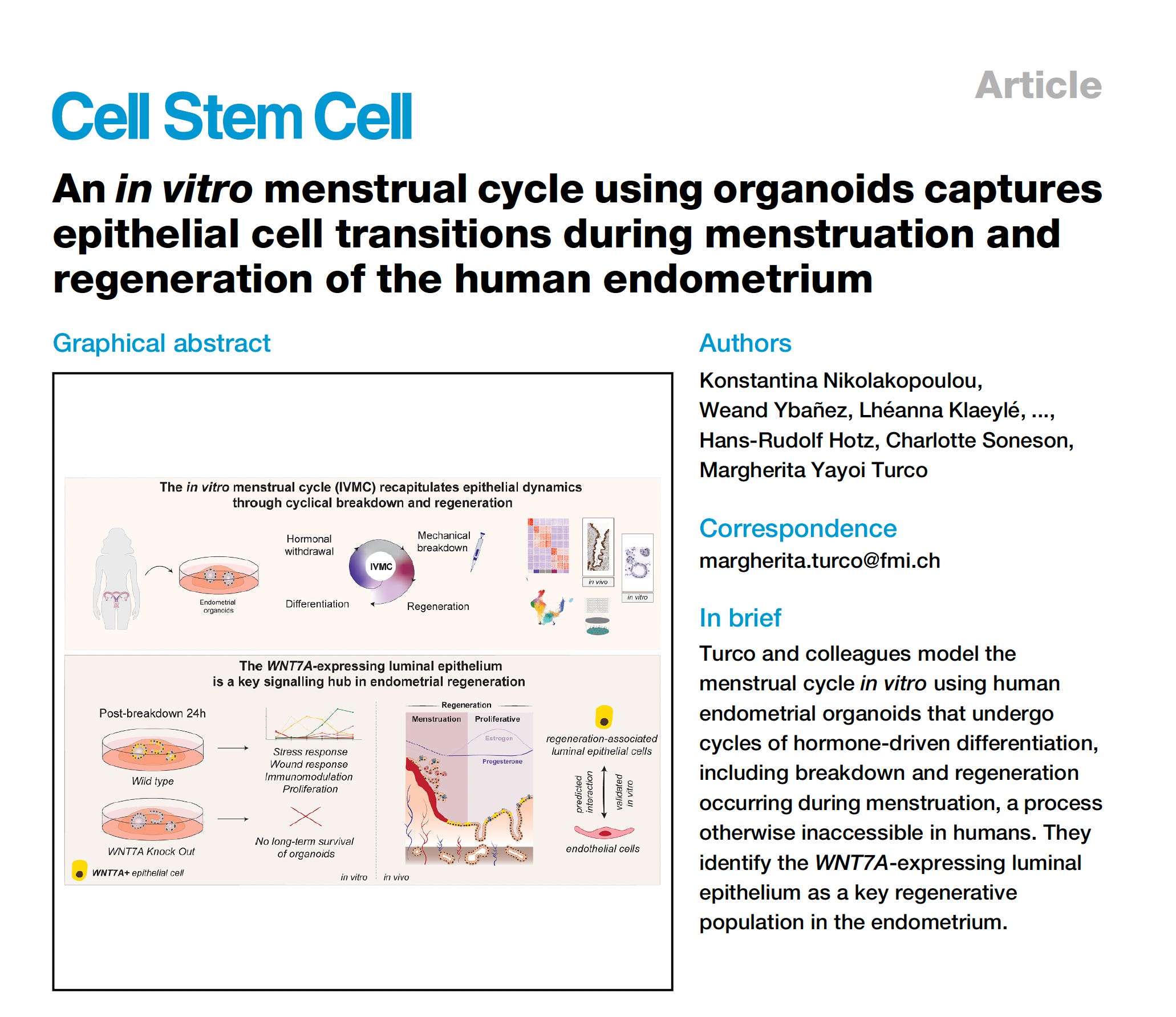
Scientists grew human uterine lining in a lab and watched it go through a complete menstrual cycle in real time. We have never been able to do this before because the window of breakdown and regeneration has been inaccessible. What they found is that the tissue doesn’t passively fall apart and regrow. The moment destruction begins, specific cells switch into a mode that coordinates the immune response, directs the blood vessels to regrow, and issues instructions for full tissue restoration. The more broken down the tissue, the more authority these cells have. There is a single molecule, WNT7A, that marks this threshold state and when scientists deleted it, the tissue eventually lost the ability to sustain itself. It only exists at the threshold and when the crossing is complete, it disappears, leaving tissue that is fully restored, and completely without scar.
This is the theology of our cells. The authority of resurrection lies in the most vulnerable surface in the system—the luminal epithelium, the innermost layer of the uterus, the first thing shed and the first that has to return. The paper describes it during regeneration as a signaling hub, meaning it isn’t just rebuilding itself but actively coordinating everyone else. It sends chemical instructions to the immune cells. It tells blood vessels where to grow back and how fast. It directs the restoration of the surrounding tissue.
The most exposed layer. The one with no protection behind it. The one that bore the breakdown completely. That is the one giving the orders.
Our flesh locates prophetic authority in the wound because it has an unobstructed view of what actually needs to happen. The body that trusts the authority of the wound is not anxious of itself. The breakdown is not a failure state but the necessary precondition for rebirth. The church’s horror at menstrual blood was always a horror at the resurrection intelligence it shares with Christ. And the church’s inability to venerate menstrual blood robs its ability to understand and practice resurrection.
This is the nature of resurrection: WNT7A doesn’t belong to the living tissue or the dying tissue. It emerges only in the liminal space and phase. The agent of threshold crossing is categorically different from the agent of flourishing. The risen Christ appears at thresholds—in gardens, on roads between cities, in locked rooms, through walls—recognizable and unrecognizable at once. The presence that carried the disciples from death into new life could not stay in the new life. It has a different identity, function, and temporality. I think of Mary, who was told explicitly not to hold on, for we cannot receive what we are gripping. The resurrection presence withdraws precisely so that it can become something we carry rather than something we hold onto.
Gripping WNT7A—trying to make the threshold permanent doesn’t preserve resurrection. And when the damage goes deeper past the crossing capacity itself, into the basal layer that was supposed to be safe because it doesn’t shed: that is Asherman syndrome. The uterine walls can fuse. The monthly cycle continues but the tissue cannot respond because it never finished the last crossing. The body is built around this knowing.
And yet, we were taught to think about resurrection as the resolution, the linear destination to hold onto: the conversion narrative, the purity testimony, the moment of being saved, the new heavenly body with no more tears and pain. We were taught to rehearse them as permanent identities rather than departure points. The narrative must be that we were broken and then we were not. WNT7A reveals a resurrection that is not a destination to arrive at and inhabit. It is a capacity you practice. The goal is not to get somewhere safe enough that the breakdown stops. The goal is a tissue capable of crossing again and again and again.
We have not been taught what our bodies already practice. Even the first line of the paper reads the purpose of the endometrium as one that fulfills its linear resurrection: “Menstruation is a remarkable physiological process in which the uterine mucosa, the endometrium, repeatedly sheds and regenerates with no scarring.” Of all the possible ways to solve the problem of monthly shedding, the miracle of menstruation is that it doesn’t leave a mark. The observation is true and not the full truth because the miracle is bigger than the body achieving a final state of not scarring. The miracle is that something moved through the body. The miracle is that the body became capable of witnessing the crossing at all. The scarlessness is the sign but not the point.
We have made it the point. And we’ve paid heavily for that cost.
When the miracle becomes the measure, when the healed body is the body God approves, every body that doesn’t resolve becomes a body in waiting. The man who walks again dies eventually. Lazarus was raised and died again. The restoration was never permanent and was never meant to be. Christ, who chose to return disabled, with wounds still open, who let Thomas touch what had not been erased, teaches us which bodies carry the resurrection intelligence. It is the body that kept crossing under conditions that could leave marks. The body that practices resurrection in ways the church never developed language for because it was too busy celebrating the miracle to sit with the one who is living it. The church’s obsession with scarless miracle bodies made Christ illegible as the site of resurrection authority and placed Christ outside the signaling hub—when the body has always followed the orders of the wound.
What is the order of a cyclical wound? The tissue that keeps regenerating without hardening does not stake its identity on the breakdown. It cannot be created by a God who thinks suffering is the point. Cyclical wounding demands a body that tolerates the threshold without collapsing it, that stays in the breaking down without immediately reaching for the coming back. The body must fully inhabit the dying, the grief, before reaching for restoration. The loss is not a blessing. The breakdown is not a testimony.
I find myself at the end of my period typing this to you in the midst of abortion bans, the systematic dismantling of reproductive healthcare infrastructure, and the increasing legislative interest in menstrual tracking data. As empire relentlessly asserts its claim over the reproductive body’s intelligence, this paper arrives and says: the endometrium has its own regenerative logic, its own signaling authority that operates independently of any external intervention. I wonder: why now? What makes this possible now?
The organoid technology is recent. The ability to culture human endometrial tissue outside the body, put it through hormone cycles, study the perimenstrual window without performing biopsy on a person continuously is new. But instruments get built when someone decides to fund them. The endometrium became legible as a site of knowledge when its dysfunction became legible as profit. Asherman syndrome, PCOS, endometriosis—conditions that interfere with fertility, are now a purchasable commodity. The paper is interested in regeneration primarily as it relates to implantation, to the endometrium’s capacity to receive an embryo. The tissue is a reproductive organ first and its intelligence is observed from the lens of it serving that function. It isn’t asking is what menstruation looks like as an end in itself, what the regenerative cycle means for the person who will never be pregnant and doesn’t want to be. The tissue’s monthly resurrection is framed as preparation for potential implantation—which is exactly the framing the church uses to instrumentalize reproductive bodies.
And yet, bodies outlast empires. Your cells don’t wait for permission to practice an intelligence that precedes and exceeds imperial claims. And we were never meant to carry this knowing in isolation. The endometrium doesn’t regenerate alone: it signals and requires response. Resurrection completes through relationship. This is what empire fears more than the individual body’s resistance: bodies that witness each other at the threshold. Bodies that say to each other, I see what you are crossing. I see what your body already knows. I will be present while you complete it.
For the astrologically inclined,
I ask you to marvel with me at the sky on this paper’s birthday: May 7, 2026. Setting aside houses and ascendant, do look at that T-square with Jupiter in Cancer opposing the Capricorn Moon, and Mars loosely conjunct Chiron in Aries at the apex. Jupiter in Cancer: memory, body, ancestral knowledge carried in the tissue, the one in whom embodied knowledge and divine knowledge are one in the same. Capricorn moon: the structure, authority of established order, the body under governance. At the pressure point of the tension between the body and the institution, Mars conjunct Chiron in Aries: the wounded body acting from its own authority. The wisdom breaking open the black box of the uterus is arriving through the Chiron wound. What releases the T-square tension lies in Libra: We aren’t resolving tension by winning. Scales don’t balance through force or surrender. They balance through disciplined encounter of finding a witness fit for the wound, finding a Mary who understands “Do not hold on to me” (John 20:17). I find this image glorious to sit with.