
How to Unbake a Cake: Sex, Shame, and What Deconstruction Cannot Do Alone

How do you separate an egg from a baked cake?
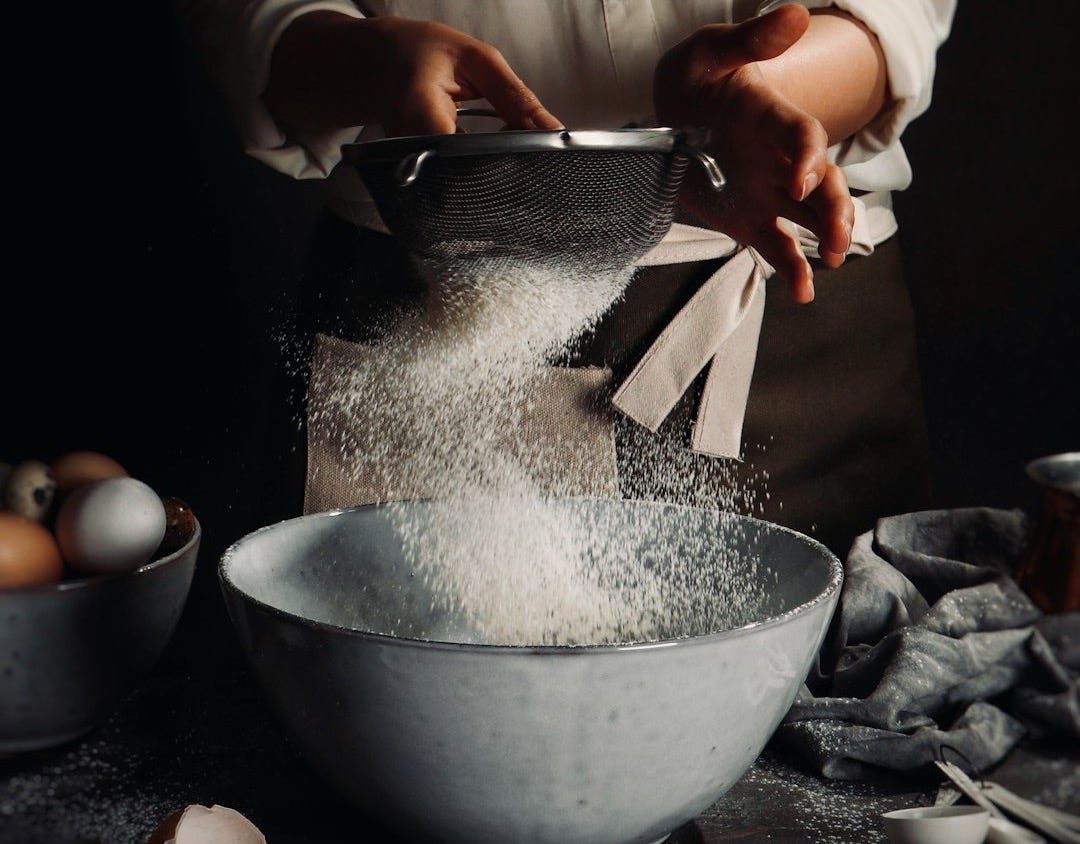
That is the question deconstruction asks of me.
The shame is already baked in. It rose with the doctrine. It set in the heat of every sermon that handed me a body and told me sex made it chewed gum, used tape, or a flower with its petals pulled off.
You cannot remove it.
But you do have other eggs. You can bake other cakes.
I remember lying fully clothed with a boyfriend on a bed when his father called his mother to warn her that we might be having sex. Our bodies were guilty before anything happened. Guilt defined my erotic body. Guilt defined what I would be worth. Guilt defined what would be left of me. In that universe, desire is a symptom of weakness, worldliness, the presence of something that needed to be confessed and suppressed and cured before it managed me.
So I learned to treat sex as contamination. I experienced my body as a problem I was responsible for solving. To say “I am scared of sex” is to say “I am scared of my body’s capacity to feel good.” That is not a neutral response to being in a body.
And shame is not a neutral response to a dangerous world. It is not just the natural consequence of doing something wrong. Shame is a theological claim about what you are.
Guilt says: I did something bad.
Shame says: I am something bad.
Neither protects you. Both protect the structure that needs you on your knees. A person who believes they are something bad does not organize, resist, and question who benefits.
So now what? You can read other recipes. You can read the Song of Songs and encounter an unwed couple where the woman describes her beloved’s body with explicit extravagance. You can learn desire is part of what it means to be made in the image of a god who creates, reaches, and wants a body as the site of revelation—not reluctantly, not as a liability or loophole, or a temporary inconvenience on the way to something more spiritual. You can understand that flesh is the fucking point.
You can know all of this. You can believe sex can be good, feel good, and still feel the shame in your body. You can intellectually reject purity culture and still flinch, freeze, feel dirty in your own desire. You will still meet it in the middle of intimacy, in the doctor’s office, in how you describe your body to yourself when no one is listening, in the way you receive pleasure, in the ways that you don’t. Because your mind changes faster than your nervous system.
Intellectual deconstruction will not unbake the shame cake. Reading new recipes alone will not manifest a new cake.
The question is not just how to undo the formation but what you do next. Will you stay in the kitchen of a tradition that told you your hunger was the problem? Or will you find your way, build your way to a different table?
I think here is where many of us stop. Because sex is still taboo. Because it is still private. Because no one will know. Because there is no community gathered around this particular kind of unbecoming. Because we don’t yet see how shame in the bedroom finds its way to everywhere outside it. To the meeting where you do not speak. To the mirror. To the ask you do not make.
Because living an erotic life seems too unfamiliar. Too luxurious. Too uncontainable. And because we have been trained to believe that wanting, really wanting, is the beginning of a big problem.
So we deconstruct the doctrine and leave the body behind, when the body is where the sacred lives.
Going back for the body is different than going back for the mind.
The body cannot be argued back into safety. You cannot think your way into a new relationship with pleasure. You have to go slowly. Work at the edge of what is tolerable. You have to build and expand on the range in which your body can feel without shutting down, fleeing, or deciding that that feeling is the problem. This means practicing proximity to what was shamed and staying with it long enough for the nervous system to learn that it is safe, that nothing bad is coming, that you are welcomed in your desire.
Reading recipes is part of this. But you will need to do some actual baking. Touching the egg on its spots, listening to the crack, watching the yolk bounce, break, and ooze into its whites. You will need to be in your body while you read and notice where the shame lives, specifically, in you. Because it is not abstract. It has a location. And it will reveal what your body knows about desire when no one is watching and no one is grading you for heaven or hell and the only question is what is true in your body. This is a practice that will change your nervous system, not just your mind.
I am in the process of developing a new container for us to go back for the body together. This is a course, a love letter to the body: “God and Sex: Deconstructing Shame in the Body.” We will practice these texts in our bodies and find out what is still alive in us underneath the formation. If you are ready to stop leaving your erotic self behind, subscribe to get notified when the doors open.
💙